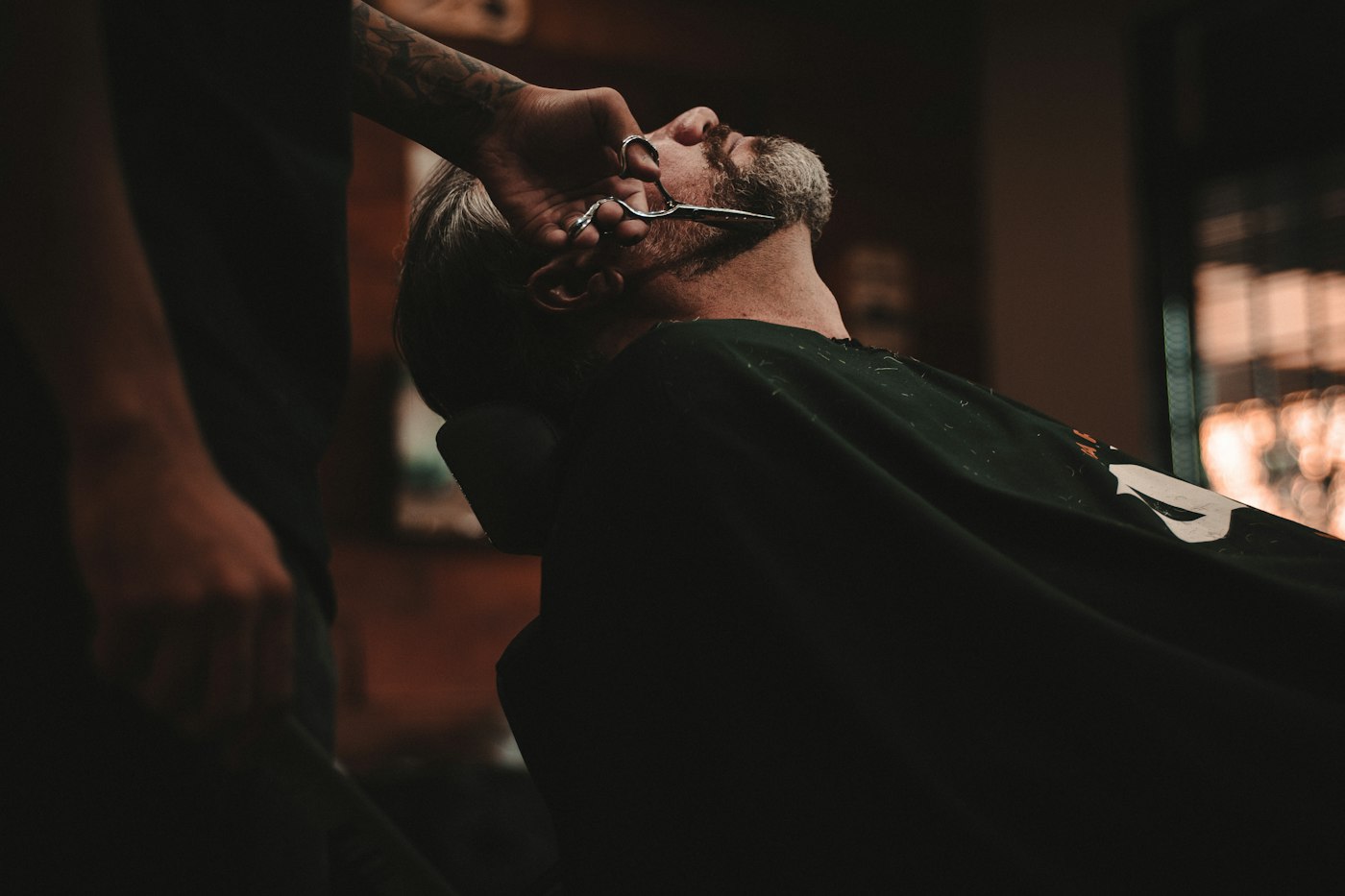
Queenies, Fades & Blunts
On the radical quiet of a queer barbershop — and what it means to finally sit in a chair that sees you.
There is a particular kind of courage in a haircut. Not the dramatic kind — not the Big Chop or the shave-it-all-off. The quieter kind. The kind where you walk into a chair and say, without having to translate yourself, this is what I want, and the person holding the scissors already understands.
I have been thinking about this since I heard about Queenies, Fades & Blunts — an exhibition that takes the language of the barbershop and asks what happens when those spaces are genuinely, uncommittedly queer. The title itself is a kind of vocabulary lesson: queenies, the femmes and the fabulous; fades, the precision taper that became shorthand for a certain kind of Black cool; blunts, the cut that does not apologise for ending where it ends. Together, they describe a grammar of grooming that queer people have been speaking for decades — in borrowed chairs, in kitchens with a friend and a pair of scissors — without ever being quite sure the mainstream institutions of hair were listening.
The traditional barbershop is one of the great contested spaces of public life. For Black communities in particular, it has long been a sanctuary — somewhere the particular texture of communal life could be held without translation. But sanctuaries, like most things, have conditions attached. To benefit from them fully, you needed to fit: in manner, in style, in gender presentation. Queer people have known this negotiation intimately. The act of sitting in a chair that might not see you — that might feminise what you asked for, or stiffen around the specificity of your request — is a tax paid quietly and often. You learn to bring a photo. To hedge. To say shorter on the sides when what you mean is something more personal than the person at your shoulder has been asked to hold before.
Hair communicates before you speak. It declares something about where you sit in relation to norms of gender, race, class, and care — whether you intend it to or not. For queer people, the negotiation with hair is often an early front in the larger project of self-definition. The length you keep or lose. The fade you finally ask for. The decision to stop doing what was expected and start doing something else. These are not trivial choices. They are, as the exhibition suggests, a kind of language.
What moves me about the framing of Queenies, Fades & Blunts is the way it refuses the hierarchy that usually governs these conversations. The queenie and the fade sit alongside each other without ranking — the femme and the masculine-read cut, the soft and the sharp, treated as equally valid expressions of a person deciding who they are in space. That is rarer than it sounds.
There is an idea that circulates in queer hair spaces: that what a client needs from a hairdresser is not just technical skill, but a kind of literacy. The ability to understand what someone is reaching for when they say I want to look more like myself. The barber who can hear that request — who knows what a certain fade signals, or how the length of someone’s hair might be caught up in questions they are still working out — is offering something the most technically proficient cutter cannot give without the right kind of attention.
Queenies, Fades & Blunts makes that literacy visible, and worth examining as both art and culture. The tools — the clippers, the scissors, the razor — become objects with history. The styles become texts. The spaces where they are practised become, finally, the subject rather than the setting.
I have a grooming edit of my own — things kept because they make some true sense, chosen rather than inherited. The logic translates to hair. And to the chairs where hair happens, and the slow, deliberate work of building a life that belongs to you rather than simply dressing the one you were handed.
The chair that sees you is worth seeking out.
The Case for Buying Less, Choosing Better
A slow argument for owning fewer things — and the quiet pleasure of using what you have until it asks to be retired.
How to Fall Asleep Faster
The small, evidence-backed habits that make the difference between lying awake and drifting off with ease.